
Attention is the new moat | BLG Thinking #1
First episode of weekly podcast/newsletter documenting SaaS marketing journey

Ladies and gentlemen, welcome to this first episode of my BLG Thinking podcast. Now you can listen to the episode podcast by clicking on the audio player directly into this post.
TL;DR
This summary has been generated by AI based on the podcast transcript.
Intro: BLG Thinking Podcast Launch & SaaS Philosophy
First episode of weekly podcast/newsletter documenting SaaS marketing journey
Two specialized AI products ready, shifting focus from development to marketing/growth
Core philosophy: Build specialized AI for specific niches vs generic solutions
Data access is critical limitation for AI effectiveness
Workflow design requires “micromanaging” AI with step-by-step instructions
Opportunity exists in specialized tools big players won’t build
Create: Product Portfolio
Hey Isabella (heyisabella.ai): Video/content summarizer
Solves “Netflix problem” of too much content, no time to consume
Bulk processing up to 45 videos in ~5 minutes
Analyzes videos, articles, ads for hooks, CTAs, emotion triggers
Includes “connect the dots” feature for saved content
Hey Enzo (heyenzo.ai): Figma design AI plugin
Enables voice design using existing design systems/components
Differentiates from Figma MCP through guided workflow vs terminal access
Ready but awaiting Figma team review/validation
Explore: Marketing Evolution & Content Strategy
Reading “Purple Cow” - marketing shifted from TV ads → remarkable products → back to distribution
Explore: Marketing Evolution & Content Strategy
Current shift: Paid media declining, earned media/content becoming dominant
US election example: 3-hour podcast (40M views) vs $100K ad spend (1M views)
Facebook/Meta ads now prioritize creative over targeting
Key insight: Attention economy requires great content, not just budget
Next focus: Learning hooks, story structure, emotion triggers for content creation
Weekly mood: Top Gun Maverick soundtrack on repeat
Transcript of the Podcast Episode
Ladies and gentlemen, welcome to this very first episode of BLG Thinking. Your host Ben, but you can call me BLG.
And today, well, this is the first episode. So let’s take our time and let’s get time to know each other or actually know me.
I wanna talk about three different things. And as always, I will try to keep up the weekly format if I can. And I also wanna keep up the format:
Create — chapter one
Explore — chapter two
Level Up — chapter three
And at the end, always the Mood that I’m currently in because I listen to a lot of music
Okay. Anyway, let’s start.
Create: The idea behind this whole thing
Now, as this is going to be the first episode, I’d like to introduce my project, what is this all about and my different SaaS.
So this whole podcast thing newsletter thing, I don’t know how you call this, is going to be around the theme of — I’ve spent the last couple months building my SaaS, and the product is ready, the software is ready, the software is working. Now, my next focus is really going to be on the marketing of it. How to get users? How to keep them? How to, yeah well how to grow, and the product.
And through our journey, I want to documenting everything I’m learning, I’m doing and that is going to be yeah, a weekly — my weekly, to do to have this kind of documentation and also that’s just me to keep my schedule and to keep doing the marketing task and the marketing work because I would usually be like that we don’t spend more time on the product. Yeah. So that is the cool idea.
The two products
Now let me introduce you to my different SaaS and what is this about because I’m talking about this, but I never shown the product. So there are currently two products. And I’m going to explain, I’m going to show, real quickly the products, but also explain — I think this is what I’m more interested in — the philosophy behind this whole thing.
So the two products are two AI SaaS. To be more precise, what I’m trying to build here is specialized AI. So an AI that is specialized in one thing and one well let’s say niche.
Hey Isabella — heyisabella.ai: A video summariser
The first one is called hey Isabella. So the website is online, I probably put it into the transcript and the post. This AI is, well, how to say, a video summariser, in a way.
Was my pain point. I spend a lot of time consuming contents — on marketing, on growth, on SaaS. How to get users, and a lot of those things. Problem is there is too much content. The amount of:
Emails and newsletters
YouTube videos
Instagram reels, TikTok, and whatever
There’s a lot of content out there and I believe those contents are really good. And to some extent, this is also incredible. Like, you can have a two hours podcast episode with the CEO of one of the biggest startups in the world. For free on YouTube. That is, to some extent, incredible.
So there’s really good content out there. Problem is I don’t have the time to consume, read, and watch everything. And that creates what I call a Netflix problem. Too much content, too much choices, too many — well, at the end of the day, I do not watch anything. I just create a watch later playlist, and I do not watch later anything.
That is why I’ve created Isabella. This AI is specialized in one thing: to analyze and summarize content. So it’s not only video content — that works for videos, that works for articles, that works for a lot of things.
And the idea here is that to have a work and a process to not only get the data — that is the first thing, because this is not only about getting the title, the transcript, and the images, the video itself from a visual point perspective. This is very going to be very important when you do want an analyze, content short form content that will perform well. And the use case is that I can summarize the content I wanna watch so that I know exactly if the content is worth it or not, and then I can either watch the full content or just watch the very specific part that I’m interested in.
And a very big feature that I like is the bulk processing. So for example, what I do is I usually go on YouTube or in Instagram and create a playlist with a lot of different content that I wanna watch. And then Isabella — I’m gonna call her Isabella because I just wanted to have a human name which is at this weird but at the same time I think it’s kinda cool — so Isabella is going to process and summarize the 45 videos in a row. So that takes about five minutes.
Once it’s done, for each and every content — there might be a video, there might be a podcast, an email, whatever — I have a condensed file with a summary. And I can read the very big part I’m interested in, and the highlights, and then I can decide:
Either that was interesting and I want to know more — so I watch and read the original content
Or I got what I wanted, and I just move on
So that is the core idea of Isabella. There’s a lot more things you can do:
Analyze short form content
Analyze ads to understand the hooks, the storyline, the CTA, the emotions trigger
Save your content — there’s a feature, we’ll connect the dots another time
You can check the website. You can also use the app if you’re interested.
So that is my first SaaS.
Hey Enzo — heyenzo.ai: Vibe Design your Figma with your existing components
The second one is hey enzo. Yeah, I’ve just decided to go with human name as brand name and maybe I’ll explain why another time.
And that is another SaaS, another specialized AI. Here’s the thing. This is completely different, and I wanna — I’m just going to explain quickly what it is before moving on to what I think is more important which is the philosophy of why I’m doing this the way I’m doing.
But Enzo is a specialized AI for Figma designers, to be able to do vibe design. So if you already done design work in your life, whether it’s web design or product design, if you’re building a SaaS, you are already using Figma. Alright. Pretty casual thing here. Nothing crazy about this.
Problem is, and especially in the last couple months, everybody wanna use AI — especially in this industry. Problem is AI is very interesting if you’re doing code and for the software engineers. But if you’re doing design work as a designer using Figma, you can’t really do anything about this. There’s not such thing as vibe design, at least right now, because well, even Figma AI is really for draft and prototype. For production work, there’s nothing like this.
And interestingly enough, a couple days ago, there’s the new Figma MCP feature that can allow access to your design and that is very interesting because this is basically what I wanted to have. So maybe my product is not that much useful after. I don’t think so and I’m going to explain why.
The point of my product is to be able that from a that a designer just open my plugin, and easily just type and the design to app. But here’s the trick. That need to be done — so vibe designing with your existing component, with your existing design system, button, spacing, design token, and everything else. That is what I’ve been doing.
So this is again, if you want more information, the site is online, but the product is not usable yet. It’s actually ready. But, as this is going to be a Figma plugin, I need to wait for the Figma team to review and validate it. But that is working.
Now why I’m saying — and I’m just going to do a quick little note on Figma MCP. The main difference is this. Figma MCP, first of all, is something that means you are basically a developer, because you are comfortable with the idea of using a terminal, using Claude code or something like that.
But even let’s say you are — even the more I spend time with AI, the more I realize that yes, it can access your data which is the first step which is most of the time very important. But then you wanna have the whole process. And you guide the AI to do a specific thing. In my case, if you want to vibe design with your existing content, you wanna say, first of all, I want you to know all my components and then you have to choose the relevant one. And so on and so forth. So this is a specific workflow that you have to teach the AI. And I think this is where the added value of my product is going to be. That the work is done. All you have to do is prompt and wait.
Okay. I’ve already went a bit too much into the product, which I usually tend to do.
The philosophy — why specialized AI?
Anyway, that was the two first products. As I said, two first products. That means — and this is where I’m going to be interested in — my philosophy, what I’m trying to build here is really a set of specialized AI for different parts of my work, but basically different parts of industries, niches, and anything in between. I think that is my opportunity. Let me explain the reason and the reasoning behind my choice.
As I said, I spent the last couple months playing around with AI. I’ve done this with my ecommerce store that I had — I just wanted to play around. What can I do with it? And that was kinda impressive. Especially with Claude Code and basically anything that is code related. The amount of work the AI can do. But the more I play with it, the more I understand — and I saw two things.
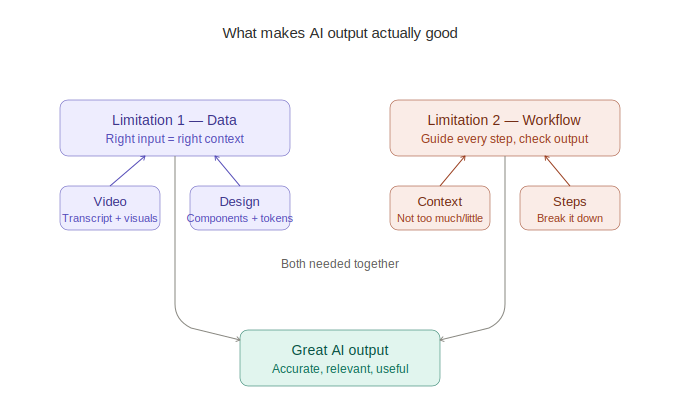
The first one is, data is super important. Like, this is what is missing most of the time. It’s not that the AI and the model is not smart enough, most of the time it is. The problem is, most of the time you do not have the right data as input.
So data as input might be the docs if you are doing code. It might be the logic. Let’s say — if we go back to my two products, we are talking about videos and — well, how do you get the content and how do you access the content of a video. Now YouTube is kinda easy, but what about Instagram? Let’s say you wanna analyze an ad or even just a short form content you saw on Instagram or TikTok. Do you have the right data? If so, what kind of data?
Do you have the video?
Do you have the transcript?
Do you have the actual visual?
And more importantly, what kind of data does the AI has access to? Same for design. What kind of data does the AI has access to regarding your existing design components?
So that is the first — I’m not gonna say limitation, but I think understanding — to best output my AI work.
The second thing that I’ve realized is the idea of workflow, of prompt, and of — you wanna give the best amount of context to the AI. Not too much, not too little. And the best explanation I can give right now is that:
If you really want to do great with AI, you wanna be a micromanager. The more you micromanage your AI, the better your results are going to be.
What do I mean by this? That means you want to teach and tell what to do, how to do it, and check at every step.
Let me tell you maybe a broader example. Let’s say that you wanna do an SEO research for your application, for your business, whatever, and you wanna use AI for that. Now what you could do is go on Claude and say, okay, here’s my website. Here’s my brand. I want you to do an SEO audit. And Claude will give you a result. Now how good is this going to be?
My thoughts on this is that what Claude is going to do is basically go to your website, get the data off your home page, and say okay I understand what kind of product you sell, what kind of brand you are. And based on this, I’m going to make a small research on Google to understand the level of competition and give you an overview of what’s going on.
Now let’s go back to our two levels of limitations:
The first one is the data. What kind of data does the AI have access to here? Not a lot. The only data he has access to is your website contents and web search.
The second limitation is you never teach Claude how to do the job.
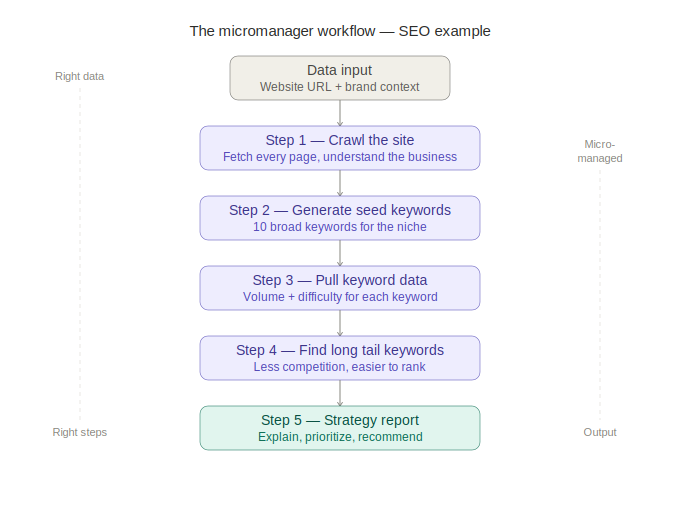
And I think the opportunity would be to create a specialized SEO AI agent that would be able to do that one thing and do it very well. If you create an AI that is specialized in this, that connects to the right data — that is the first step, getting the right data: how much volume a specific keyword is getting monthly and the difficulty of that keyword.
Second step, micromanage the AI. Because you wanna tell it: if the user wants to do an SEO market research:
Go on the website, fetch each and every page to really get an understanding of the business
Generate a list of 10 broad keywords relevant to the business
Get the actual volume and difficulty for each keyword
Generate a refined list of long tail keywords — less competition, less volume, but easier to target
Review and explain to the user what is the best strategy
As you can see, not only I’ve given the AI the right data to work with, but I also micromanaged each and every step to explain and teach the AI how to do it.
And I think this is, at least from my point of view, the opportunity right now with AI:
If you try to do a generic AI, at some point a big player is just going to kill your startup in about three days
But if you do a very specialized tool for a very specific use case in a specific industry, that might work — because no big player will do this, it’s way too specific
Specialized beats generic. Every time.
And it requires having access to the right data, connecting specialized tools first, and also creating a specific workflow for that specific use case.
So in my opinion, and this is what I’ve been working on for the last couple months, that is an opportunity that I think might be really useful and be interesting to go with. And I’m trying to do this, so let’s see how it goes.
Now again, I’ve already spent way too much time on the first chapter which is create. That is fine. But now it’s time to move on, and I think I’ve way more stuff to say about this, but that will be for another episode.
Explore: The Purple Cow
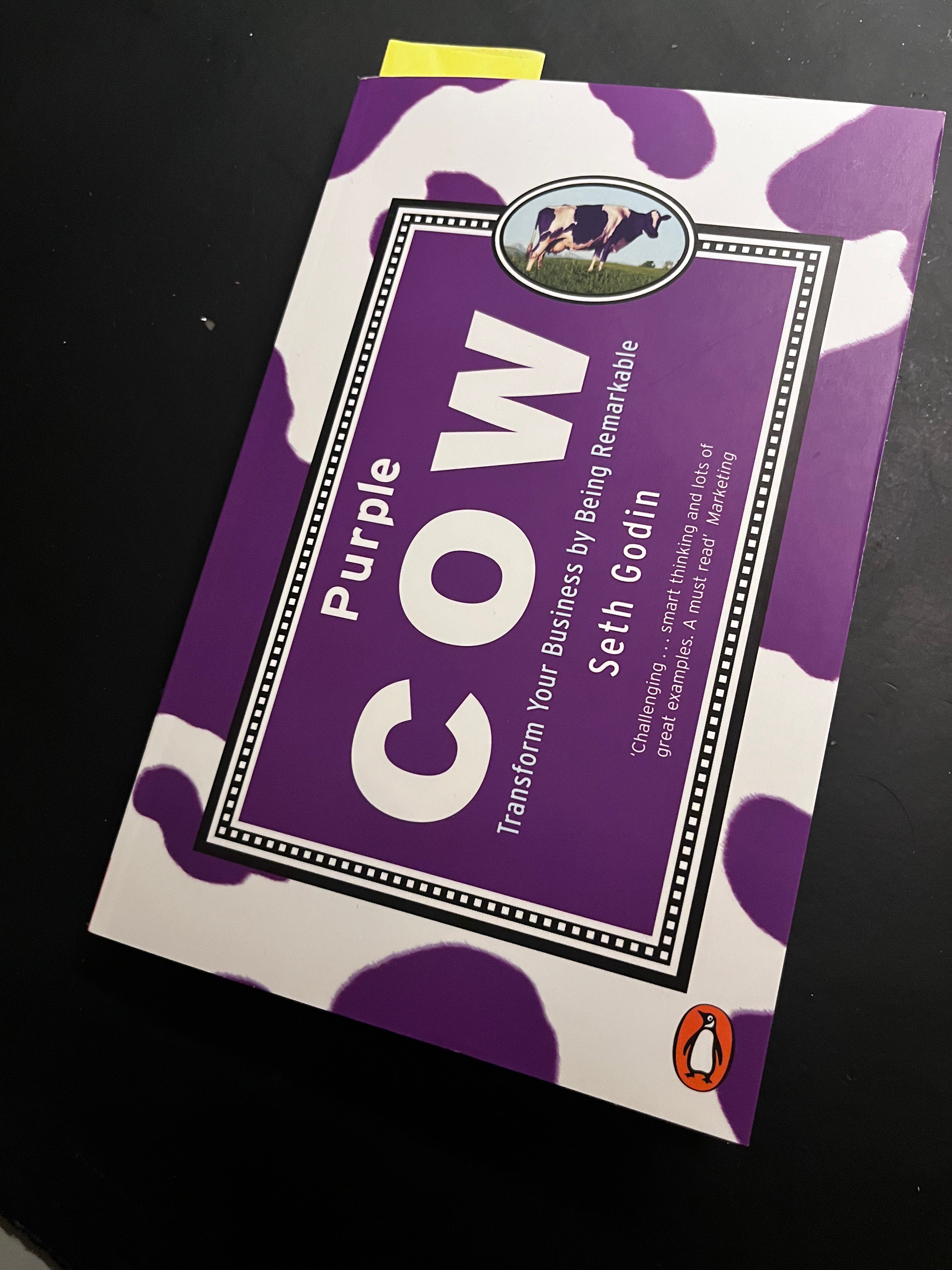
This week actually, I’ve been quite busy still optimizing a little bit the product and setting up everything, but I’ve spent a couple hours reading the Purple Cow book. By — I’m sorry. I do not remember the — I’m actually never remember people’s name. That is terrible. But whatever, famous guy — this is This is Marketing, and I wanted to read the Purple Cow which is a less known book but I think this is very interesting.
Because in the book he goes into the history of marketing and advertisement especially in The US. And I think that is — now this book is a bit old, I think it was written in 2002, if I’m being correct. And so it’s a bit old compared to what we have right now. It’s not like, how to go viral on Instagram. There’s definitely not going to be that in the book.
However, I think this is interesting to understand the history of marketing and of the advertisement industry. Again, just like investing, past performances do not predict future performances. However, it is still very interesting to learn from it.
So I’m not — I’ve not done the complete book. I think I’ve actually thirty forty pages in, and the book is pretty small. So that should be pretty quick to finish.
What I like so far
What I like about this is that he goes to say that the first phase of marketing was with the TV industry in The US. That itself created a complete — I’m not even gonna say industry, but a complete economic change in the way people buy, consume, and how companies are making money. Because at that time, you would basically have a TV spot and an ad spot. And if you had that, then you create a product because you will be creating the demand in the first place. So basically he goes that before it was really about marketing and distribution.
And now — put that in context, the book was written in 2002 — but around that time, it’s not working anymore because people are just fed up with ads and they don’t get their attention anymore and they just don’t care about the ads and just watch it and don’t care, move on.
So now, in order to get seen and to get known, you have to be remarkable. And this is the idea of the purple cow. The name cow, I believe, comes from the idea that he went on a trip in France and there were a lot of cows. And at first, it was impressive, and then about a couple days after he was just like, well, yeah, it’s — you know, it’s I’ve seen thousands of them for the last couple days, so I’m used to it.
If you wanna be seen, you have to be a purple one. One that stands out of the crowd.
And this is basically saying that you wanna have a product that is genuinely interesting and innovative.
My thoughts on it
So this is where I am in the book. Again, I don’t know where it is going to go after that. I think this is interesting. But I think this is not quite true for most products.
Now, obviously there’s a lot of truth into that — the ad fatigue thing is real — and that is true that every kind of marketing will at some point just be used and most people will be tired of it. And you have to move on and find a new thing. TV ads used to work like wonder and now, at some point, most people just become used to it, and to some extent, they become bored and just blind to it.
But that is true for pretty much everything. Like, you can say that for TV, but to this day, there’s still TV ads. There’s still a lot of brands that are still making most of their money from ads. So:
True that there will always be ad fatigue at some point? Sure.
Say that this is completely over? I think that would be absolutely not true.
Considering that ads will never go out. The moment there will be people that are ready to watch ads instead of paying for something — so instead of paying for Instagram, you wanna use Instagram for free but watch ads — there will always be advertisement.
Now by the way, great example of that would be Netflix. Netflix — I don’t remember if that was last year, maybe even before that — they introduced their plan with ads and everybody was like, that’s crazy. This is complete nonsense, I will never pay for this, blah blah blah. Well, turns out that is I believe their most popular plan — people buy this the most — and once they did that their growth went up again. Again, this is not the only reason, but you got the point.
And I think that’s interesting. But there’s some truth to that — that ad fatigue is real, and to some extent, forcing people to see something at the end of the day will always fade and be less effective over a period of time.
However, what I really agree with is that his solution is just a very simple one — to be remarkable. You have to do is be remarkable and create the best product ever. Obviously, I think there’s some truth to that. But I believe this only works if you’re really in the top 1% of products. Like, if you are really building a product that will massively shift if not change or create a new industry. For example, if you create a GTA 6 level product. Sure. That strategy will absolutely work and you probably don’t need marketing at all because people are gonna talk about the product anyway.
Sure. And he’s talking about this. Talking about what I believe is called the idea virus. So ideas that just share by themselves.
Level Up: We are in a weird spot with marketing and distribution
And that, I think, makes a great transition to the last chapter of this, which is level up. And in this section I’m just sharing one key lesson I’ve learned this week.
And this week, I think this is going to be related to what I’ve been saying about this book. I believe that right now we are in a weird spot when it comes to marketing and distribution.
Because basically let’s go back. The history kind of looks like this:
TV era — if you had the ad spot on TV, boom, you won, then you figured out how to create a product. Distribution is the key.
Product era — most people were like, you have to be remarkable, you have to create the best product ever. This is in those periods that you got the best products — Airbnb, that kind of stuff. But again, we’re talking very very top 1% products that will actually be an industry shift.
Paid media era — social media ads and Google ads came in. So back to: distribution is the key.
So there was a back and forth between product and marketing.
But then right now we’re kind of in a different situation.
Creative is the new targeting
Because even though paid media is still and will always be a thing, you can see it start to decline a little bit. And not only that, especially from the attention point of view — like do people remember your ads? I don’t think so.
However, in the meantime, something happened which is earned media, which is content, which is social media content.
And to explain that, I’m going to take — and I’m going to do this. Yes. Okay. This is the first episode. I’m already talking politics. Crazy. But I’m talking about the US election. I know I know. Again, I’m just not going to talk about the ideas. I don’t really care about that, but I do wanna talk about it from a marketing perspective.
If you think about this, the Democrat party always had more budget than the Republicans. Again, this is not about ideas. I’m not saying it is bad. I’m not saying it is good. I’m just saying it is. From the paid media to the marketing, they had more budget. And that election was no different. They spent more on the marketing, on the ads, on whatever than the other party.
However, they didn’t win. But more importantly, I think to some extent, this election has been won because of a podcast episode. And two very different strategies:
One candidate did a three hour podcast episode
The other spent 100,000 to recreate the studio set
The difference in views? 1,000,000 on one side, 40,000,000 on the other.
Now my marketing view on this. The person that won was the person with the most amount of distribution. So we all come back to the same idea — if you have more distribution, your product, quote unquote, will win.
However, and that is where it’s interesting — as before, in order to get the attention of people, you had to pay. So that was paid media. If you are able to pay more than your competitor, you will get more attention than your competitor, and you will win. That was TV, paid media, whatever. And most of the time it works.
But now it’s not the case anymore. Because in order to have attention, in order to have more views, you don’t really need to pay — but you need to create, quote unquote, great content. And that content will do the distribution by itself. Through algorithm and social media.
So this is a very interesting shift because we went from a pay to win system to now — all you have to do is create the best, quote unquote, content in order to get the attention.
And I think you can also clearly see that change in the way Meta Ads is shifting. Because for so long it was about targeting — if you were very technical at targeting people with the right audience, not too broad but not too narrow, you would have won. And now, Meta ads doesn’t want you to do anything. They just want you to focus on the content and create the best creative.
Creative is the new targeting.
Attention is the new moat
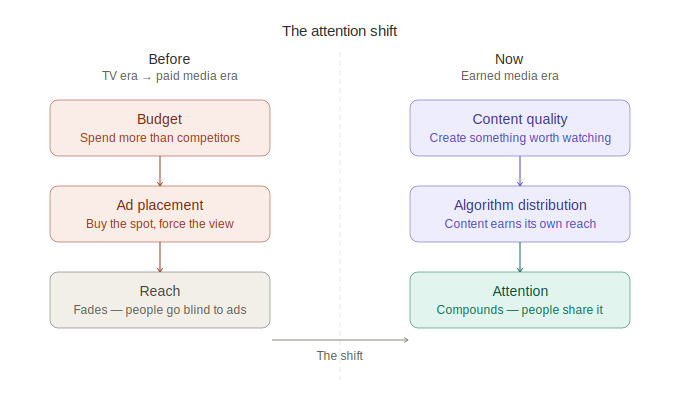
So now we see a shift where in order to get people’s attention, you really want not to focus on how much money you can spend but how great, quote unquote, your content can be. And that goes beyond just marketing and trying to launch a business even though this is what I’m trying to do. This is the same case if you’re an artist and you’re trying to launch a career out there. And even to some extent the political stage as well.
So that is I think the shift and I think the key lesson.
Attention is the new moat. And to get attention, you don’t need the biggest budget anymore — you need the best content.
And this is why I wanna spend the next couple weeks and months to really understand that. And basically understand maybe the most important skill in this century — how to get people’s attention. And I think there’s a lot of interesting things to learn from:
The hook
The story
The structure
The emotion triggers
And I think that might really work. But again, I need to learn how to do this. And I think with the right volume and intensity, I can achieve results.
So again, we’ll see. If you’re interested, follow along.
Mood
And finally, to end up this first episode — I wanna talk about the mood of this week.
Well, this week, I’ve rewatched Top Gun Maverick. Very great movie. I’ve actually never watched the first one so I’ve watched the second one before watching the first one, but whatever. And I’ve been — this is something that happens with me all the time. That’s terrible. But every time I come out of a movie, for the next couple weeks, I just keep listening to the music from that movie.
So that is the song of this week. Because this week there’s a song — I think it’s the main theme of Top Gun — the song is called Danger Zone... wait no. Okay well you know what the song is called.
Ladies and gentlemen, this is how this very first episode is going to end. I will try to keep the weekly format and I like that it also forces me to document and keep me on track.
See you in the next one.