

Ladies and gentlemen, welcome to this second episode of my BLG Thinking podcast. Now you can listen to the episode podcast by clicking on the audio player directly into this post.
TL;DR
This summary has been generated by AI based on the podcast transcript.
Intro: Isabella SaaS Positioning & Product Focus
Repositioned Isabella from multi-purpose content tool to specialized AI summarizer
Core value prop: “consume more content in less time and remember everything”
Target audience: people following 12+ podcasts, 30+ Instagram accounts, 40+ YouTube videos
Problem solved: forgetting 90% of content within 48 hours
Product workflow: paste content → get structured summary with key takeaways → auto-save for search/recall
Goal: skip noise, keep knowledge in one place
Optimization work completed on product deliverables
Create: Distribution & Marketing Strategy
Three-constraint goal: get attention at scale, fast, and free/low-cost
Four-part distribution plan:
Organic social media (primary focus)
Short-form content emphasis
Belief: creators will become entrepreneurs, brands will shift from paid ads to creator ecosystems
Can achieve scale quickly with creativity + business understanding
SEO (secondary focus)
Classic SEO + GEO (AI search optimization)
Advantage: retention of scale once achieved (can last years)
Limitation: slow (6-12 months), difficult for new domains to compete with established sites
YouTube SEO (tertiary)
Hybrid approach combining social media + SEO on YouTube platform
Branding integration
Focus on triggering positive emotions, having strong opinions
Isabella positioning: curation tool, not replacement for original content
Explore: Marketing Research & Framework
Core marketing principle:
Where
Who
What
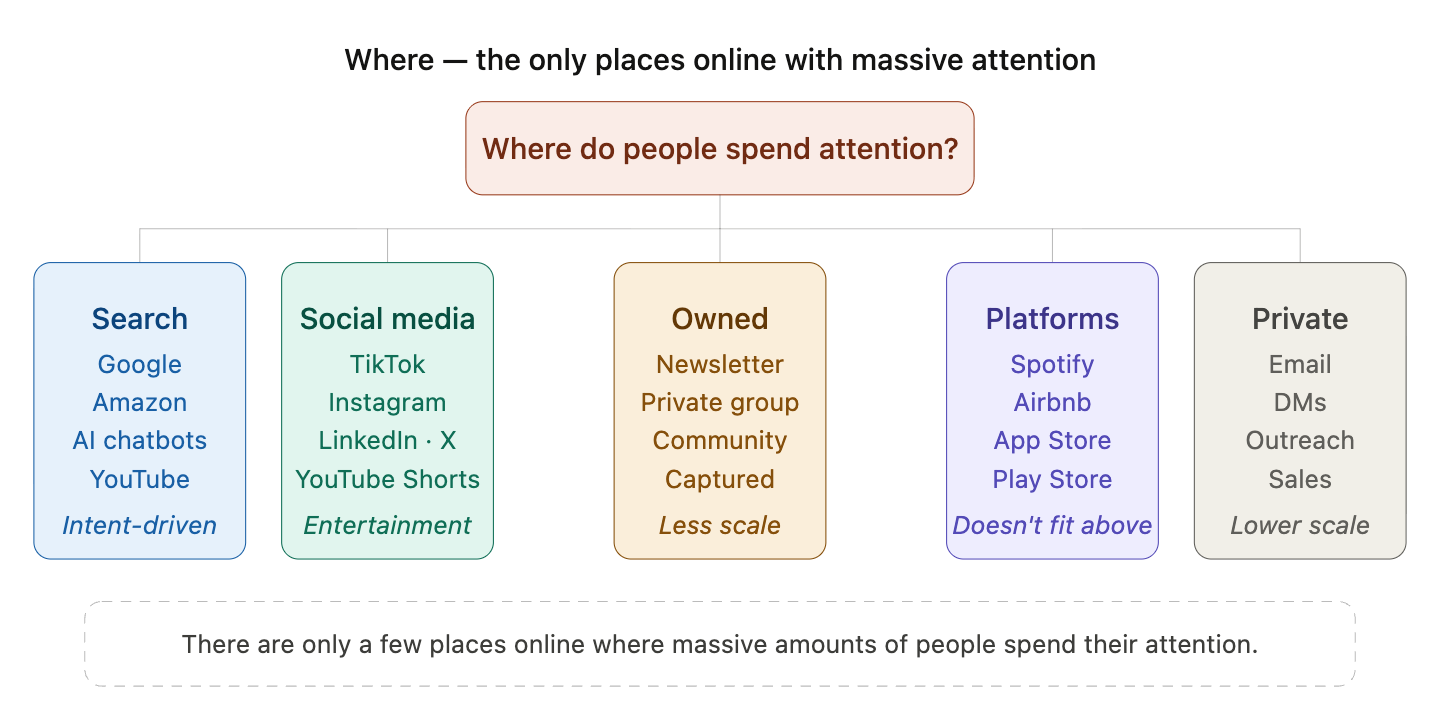
Five categories where people spend attention online:
Search platforms (Google, Amazon, ChatGPT)
Social media (YouTube, Instagram, TikTok, LinkedIn)
Owned audiences (newsletters, private communities)
Other platforms (Spotify, App Store, Airbnb)
Private communications (email, DMs)
Two approaches to get attention:
Doing the work yourself (you or the company): paid ads, content creation, sales/outreach
Using others: existing customers/product exposure, user-generated content, affiliations
Level up: Personal Brand Launch Partnership & Next Steps
Signed up for Personal Brand Launch (PBL) service with Ava
3-month program starting last Friday
Focus: short-form social media content creation around Isabella
Planning to create AI tool for content research:
Analyze top TikTok/Instagram content in specific niches
Extract hooks, content structure, CTAs from outliers
Provide research foundation for human creativity
Current revenue: $0 (expected for 2-week-old product)
Transcript of the Podcast Episode
Ladies and gentlemen, welcome back to BLJ Thinking. So this is the second episode here, I’m documenting my SaaS journey. So, again, we’re just getting started. Revenue is at $0 right now, which is kinda expected. The product was just finished about one, two weeks ago, and now this is really about starting to get the focus on distribution and marketing.
So well, the last couple of days, I’ve been quite busy doing a lot of research on distribution and marketing. Well, just before that, let’s keep in the flow and let’s introduce quickly what I’m going to discuss in this episode.
As always, we’re gonna keep the create/explore/level up format and at the end, the mood for the music of the week.
In this episode:
Create — I’m going to talk about what I’ve done for my SaaS. This episode is a lot about research. I did do some changes about the product, but this is really optimization more than anything else.
Explore — This is really where I dive deep into one subject that I think is interesting. Today, it is going to be about marketing and especially about distribution and how it is very simple yet very hard.
Level Up — I’m going to talk about a partnership I’ve just signed up for.
1. Create: Positioning Isabella
So as I said this week, I’ve done a lot of research and I’ve read and consumed a lot of contents on marketing, distribution, growth, and you name it. Now before that, I did do some positioning work on Isabella, my product.
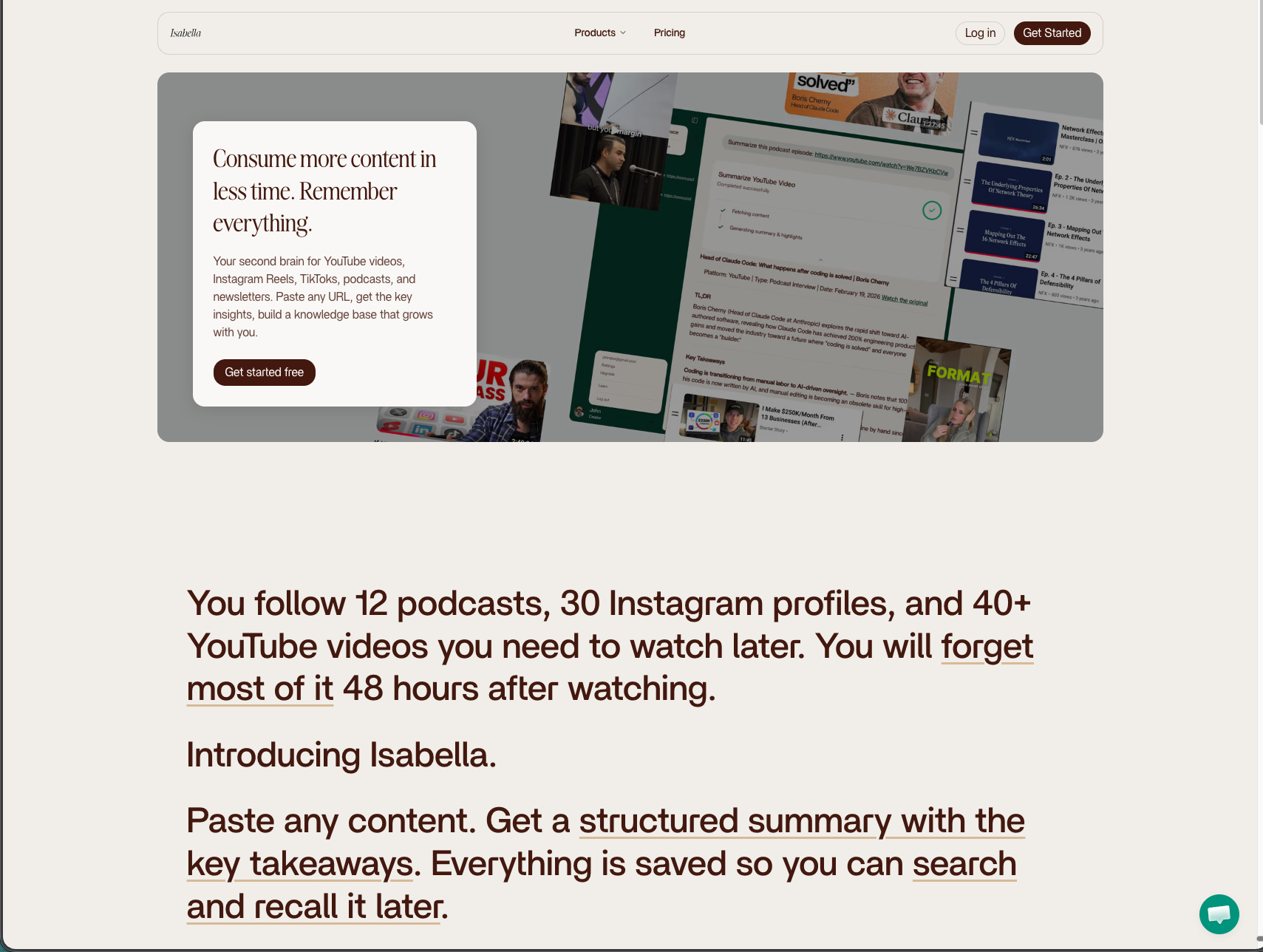
So just to quickly sum up, Isabella is my first SaaS. This is a specialized AI about summarizing contents so that you can — I’m literally going to go on the website and read you the H1 — you can consume more content in less time and remember everything.
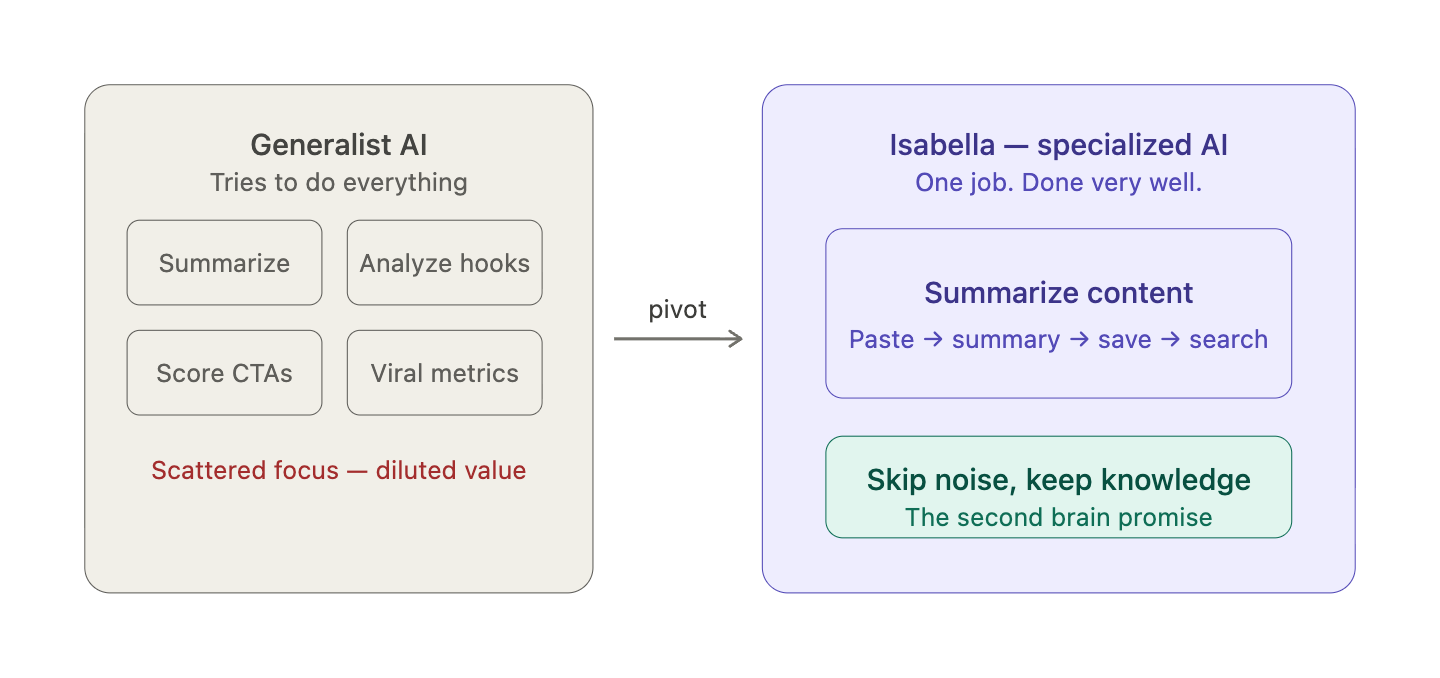
I’ve done a lot of positioning work here because first, a week ago, Isabella was a lot about, well, not only summarizing content from social media but also analyzing it — you know, the hook, the content, CTAs. So that was really about content creation at the same time. So I was trying to make the product do different things, which is not really the product vision overall.
The goal here is to have one specific AI that does one specific job and does it very well. That’s the goal.
So this is why I’ve worked a lot on the marketing website of Isabella to position the product as, yeah, a second brain to some extent. That means that your target audience is going to follow 12 podcasts and a lot of 30 Instagram pros and you probably have 40 plus YouTube videos that you need to watch later. Truth is you will forget most of it in the next forty eight hours after watching, and this is where Isabella is going to help you.
Because now you can just paste any content, ask her to summarize it, get a structured summary with the key takeaways, and then everything is saved automatically so that you can search and record it later. That means you can skip the noise and keep the knowledge — everything at the same place.
So this is really the goal of Isabella. And actually that is a problem I had in the first place. I am consuming a lot of content on a lot of different subjects, whether it is marketing, but it might be entrepreneurship, business, design, code, whatever. So there’s a lot of content out there, and I think we live in an era where it’s pretty great to have access to all that kind of information, but at the same time, it’s too much.
There’s a lot of content. And I think we can easily spend more time consuming content instead of taking action. And even if we do consume the content, which already takes a lot of time, most of the time we just forget the key takeaways that will really move the needle in our case. So that’s the why behind Isabella.
Research Done This Week
So that is what I’ve been doing this week. A lot of work on positioning. I’ve also optimized the product and vision with the deliverables, but this is a bit too product-focused to talk about extensively here, so I’m going to skip that part.
Now the real work has really been about consuming content. And I did use Isabella a lot for that, actually. A lot of research from:
Books — like I said last week, Purple Cow, but also Hitmakers, which was a book I read a couple years ago, but that was great to have some kind of refresher
A lot of articles from Reforge, which is specialized in growth and startup in the startup world
A book on growth marketing
Lenny’s Newsletter
I’ve also spent quite some time analyzing “where did you hear about us” sections in multiple different products and services
Alex Hormozi — obviously
NFX Network Effect — that was a very good finding during my research
Every time I sign up to a product and they ask me where did I hear about them and their product, I just take a screenshot, and I have a massive folder with, I don’t know, hundreds of screenshots about that. And I think this is very interesting to just kind of reverse engineer what they’ve done and, well, what is their marketing strategy, and how do people hear about them.
The Plan
And finally, all that research ended up with me doing my plan for my SaaS — and my different SaaS, really. So Isabella is only going to be the first one. I can already have a second one that is waiting to be reviewed and validated. And I also have a lot of different ideas and I can quickly create new specialized AI SaaS.
So the plan — before explaining the actual plan, what is the goal? The goal, in my case, is really more than just making it and getting users and getting distribution and, you know, making the SaaS and the product grow. It’s a lot more about understanding and having some kind of process and workflow that I can repeat multiple times for multiple products, but actually for multiple brands.
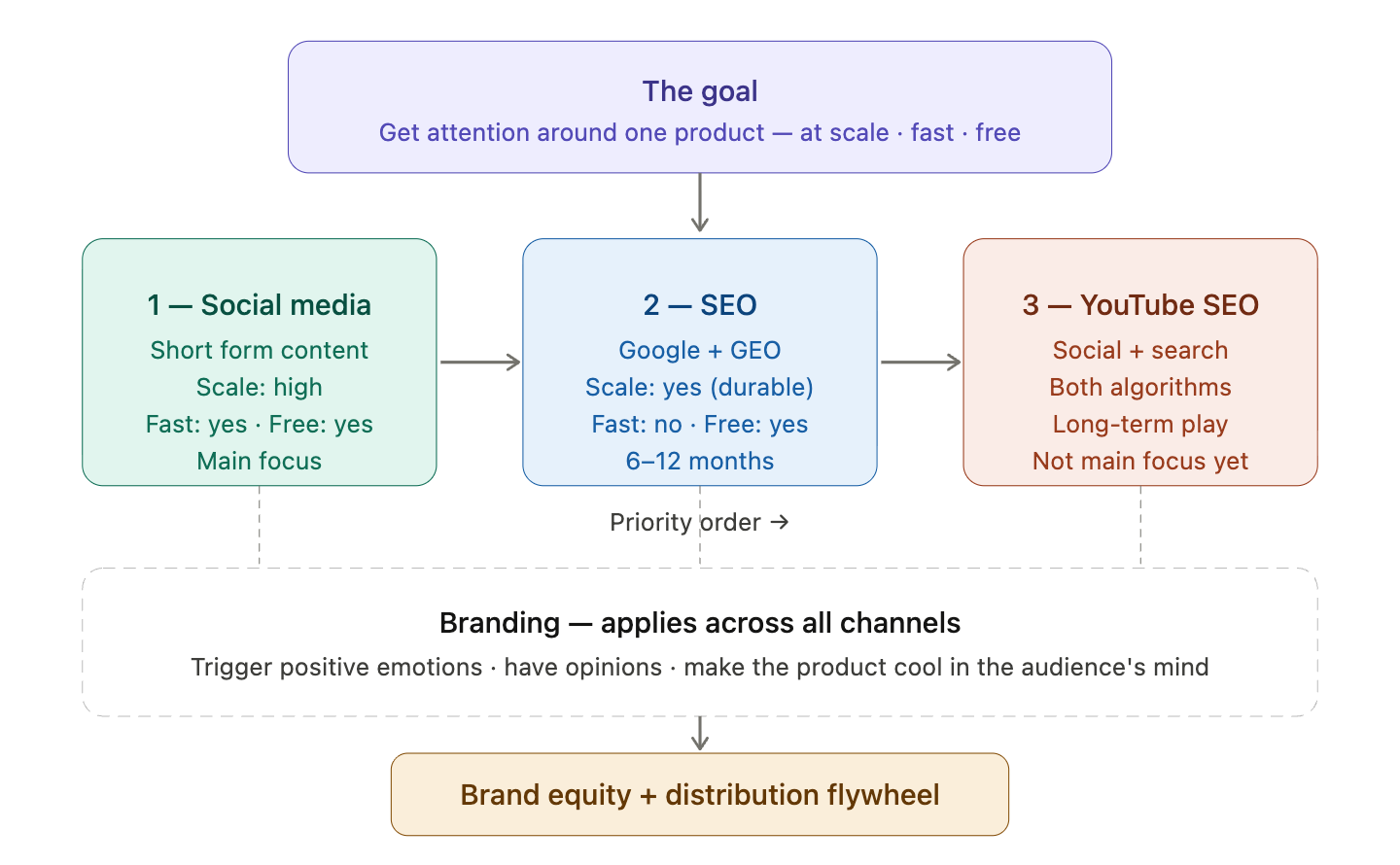
Here’s the goal: get people’s attention, around one niche, one product. At scale. Fast. Free/low-cost
That is ambitious. Let’s be clear about this. Because what I want — get people’s attention, around one product — but with three constraints:
At scale
Fast
Free — at least does not require a lot of money
Part 1 of the Plan — Organic Social Media
The first one is going to be organic social media. Especially, I’m going to focus on short form content.
Not only that, but I also want to understand the process. Here’s my view — and this is something I’m going to talk a little bit more about in the explore part of this episode. But I think social media, especially organic social media — and this is what I said I think in the last episode — is really something that is going to be more and more important.
Because currently, the state of social media is that it’s mainly influencers and mainly content creators. So this is the creator economy. I do believe — and this is something we kinda see at a really top level, this is definitely not the norm — I believe in the next couple of years, if not decade, that is going to be the main way for the best and the worst, that people are going to get their attention. And they are not only going to learn and learn the news and stuff like that, which is kinda already the case, but also make new purchases.
And I think brands are going to really pivot from a paid strategy to an ecosystem strategy. Because most brands, especially big ones, especially if you have some kind of VC funding, what you basically are doing is you are going to spend a lot of money on ads.
Now what is going to happen is I think it’s going to be more broad. So you’re still going to have that paid part, but then you are going to have some kind of sponsoring of existing influencers, some kind of affiliation sponsoring. But what I think is going to be more and more the case is that we are going to have some kind of long-term collaboration between one or multiple creators and a brand. So this is not just about sponsoring. That’s the real difference — I think the creator is going to have a specific place and importance inside the company. I think MKBHD has something like that, but this is going to be more and more the case.
That is one way. So we’re starting from the brand, and a brand is going to use creators and the overall ecosystem of social media. But there’s also another path — which is something we kinda see and are going to see more and more, especially as with AI the cost of creating and building a product in a company is going to be lower and lower and lower — where creators themselves are going to turn into real entrepreneurs. And real, you know, business people that are going to create their own brands and companies.
This is to some extent already the case, but really not exactly. Except if you are going to be at the top level — but these people have a whole team behind them. What I think we’re gonna see is creators building a product and using and then creating an audience around that. And then, well, you can easily turn that into a brand, do more paid affiliation with other creators. But I think that is going to be more and more important, especially online.
So all that to say, the first part of my plan is organic social media. Especially right now I’m going to focus on short form content.
Now let’s check against my three constraints:
Scale — I can scale pretty fast to a pretty large audience with organic social media. Obviously, there’s a ceiling at some point. This is where you’ll need to either go with other people’s audience — whether it is a collaboration, a sponsoring, affiliation, whatever — or go with paid. But the ceiling is pretty high if I’m being honest. And you can break that ceiling by adding more and more distribution.
Fast — I think this is the real deal of organic social media. If you do this right — and I think this is going to be the very complicated part — you can go and achieve a level of distribution and a scale that is pretty fast. Obviously, this requires a lot of work and a lot of understanding that I do not have right now about how it works. And also — and I think I do have that — you have to be fucking creative. I think at the end of the day, content creation comes down to creation, which comes down to being creative. And I think you can apply the power law of media to this. When you look at media, there’s always a power law — the top 1% of media is going to be watched by a lot of people, and then it’s just going to have a long tail. A very minority of media — whether that’s social media, music, movies — is going to be a big hit, and then there’s a long tail. The difference is almost impossible to predict. There’s a lot of luck involved, there’s a lot of timing involved, but there’s also, at the end of the day, a question of talent and creativity. And I think if you can combine the creative talent part and the business, quote unquote — the marketing and the understanding of the game — you can win this, and you can win it quickly and for the long term. Now that is my bet. Not sure if I’m going to make it.
Free — Organic social media is, to some extent, free. It does not require a lot of money to get started.
Part 2 of the Plan — SEO
The second part of my plan is going to be SEO. So same idea, this time on Google search. And when I say SEO, I’m talking about SEO, but also GEO, which is the new thing with AI — even though everybody is talking like they know how it works. Truth is nobody knows how it works. So right now, the best bet is just to do classic SEO but for maybe more question-type search, instead of keyword search, that is mainly the only difference. Until one of the big AI players publishes some kind of guidelines here. Right now, everybody is trying to figure it out.
But SEO is very interesting as well because it’s free. It can scale. And I’ve done SEO in the past — if you want the full workflow, I started my career as a freelance web designer, working for clients and for companies to do their websites. And then I switched and I started an ecommerce. That ecommerce is still a thing. It’s a niche thing. It’s making about 10k a month — again, this is not revenue flexing by any means. We have about a 50-55% margin. So that’s a small thing. You can easily operate it solo, so that’s kinda cool. And the main distribution channel here is SEO. So I do have some kind of experience here.
Now let’s check SEO against my three constraints:
Scale — SEO can scale. Yes. And I think to some extent, the one thing that SEO does better than social media is the retention of scale. That means once you are in the top one, top two place in Google for keywords, that can last for years. Obviously it’s very difficult to get there in the first place. Sure. But you can stay here for years without having to do anything. And this is something I kinda see with my ecommerce site. I’ve been really focused on SEO for about three months — I did a big revamp of the SEO strategy for three months. And then it just keeps working. That is pretty much impressive.
Fast — Absolutely not. SEO is long. This is going to take at least three months, and three months is pretty optimistic. In reality, it’s gonna take six months. It might even go to twelve.
Free — Yes. And I think this is even better than social media because you literally only have to write text at the end of the day.
However, there’s something important to say about SEO — and this is quite the big difference between SEO and social media — you cannot blow up on SEO the same way you could on social media. Like, even if you write the best content ever created on a single keyword subject, you will not be top one immediately. You might be on page one pretty quickly if you do your job right, but that is already complicated.
Why? Because SEO is not only about writing for the right keywords — which is obviously very important — but also about how difficult that keyword is. And the more difficult it is, the more it’s not just about how good your content is, but how trustworthy your brand and your domain is for Google. And if you’re just getting started, you are not trusted. Because the whole idea of being trustworthy to Google is:
To have a lot of traffic — but how are you supposed to have a lot of traffic if you’re not trustworthy and Google doesn’t send you traffic?
Having a lot of backlinks from trusted sites — but again, how do you achieve that?
And for example, my ecommerce example — we are about 15, maybe 20 thousand traffic right now, depending on which platform you’re looking at. The numbers don’t really mean anything in isolation — if you’re watching on Shopify, if you’re watching on Google Search Console, if you’re watching on SEMrush, it gives you something completely different. But we’re around that range.
The best competitors in our niche can achieve about 40 to maybe 60,000 — again depending on the actual website and platform you’re looking at. So we’re still three times less than the leader in our niche. And to get there, it’s almost impossible if we rely only on SEO. Because we cannot compete with them — we are in the niche since two years, and they have been in the niche for more than twenty years. We just can’t compete if we’re only playing by SEO rules.
So that is why — and I think this is the best thing about social media — you can achieve a level of trust very fast. Again, that seems very complicated. That requires a lot of creativity. But if it does work, that can also feed the actual SEO and bring you way more results in SEO than you could actually get just by focusing on SEO itself.
Part 3 of the Plan — YouTube SEO
The third one is going to be some kind of mix — YouTube SEO. So this is going to be about creating YouTube content but focused on SEO. I’m not going to extend on that, but this is pretty much trying to do both social media and SEO on YouTube. So that’s going to be interesting. There’s a lot of good ideas here.
Even though that is not going to be my main focus. My main focus is going to be, in order:
Organic social media
SEO
YouTube SEO
Part 4 of the Plan — Branding
And finally, a fourth part of the plan is branding.
Now branding — there’s a lot of things about what is branding, what is not branding. But from my understanding, which might be wrong, branding is about triggering positive emotions to your ideal audience. And by that, once you trigger those emotions, that is going to create some kind of connection between your brand, your product, and your ideal audience and that emotion. Basically, you wanna make your brand and your product cool in the mind of your ideal audience so that you can charge extra. And have some kind of branding advantage.
But okay, that is all theory. How do you do this in practice? In practice, that is done through media. I don’t see how you can actually do branding with SEO itself. Sure, some might argue that you can do this by creating some kind of tone inside the content, which is true. And then you can create a newsletter, which will create a tone, which is also true. I think that might work. But that is not going to be as powerful as actual content from media. And this is done through two ways:
Paid media
Organic media
So that is going to be interesting how I can put more branding into my contents, into my SEO. And in my case, branding is really going to be about having opinions — about how you should, yeah, really about having a way, an opinion, about how and why you should do things a certain way.
What does that mean? I mean, in the case of Isabella, the goal of the product is not to replace the content by just stopping watching it and instead summarizing. The goal of Isabella is really to — well, take a lot of content you wanna watch, summarize a lot of it because you can bulk-summarize an entire YouTube playlist with 45 YouTube videos, whatever. Read each summary and quickly read the key takeaways. And then if there’s one key takeaway and you’re like, okay, that is interesting, that is very much what I need right now in my current situation — then watch the original thing.
This is more like a curation than it is about replacing. It’s really about curating the content you wanna watch and having some kind of priority order.
So I’m going to try to put a lot of branding inside my contents, my SEO. And yeah, that’s pretty much it.
Part 2 — Explore: Marketing Is Very Simple, Yet Very Hard
So I’ve talked a lot longer than expected, but that is fine. Let’s move on to the second part, which is explore.
In today’s explore part, we are going to talk yet again about marketing. And here’s what I’ve learned about marketing this couple of last years and especially the last couple of days, where I tried to do a lot of research.
Marketing is very simple. Yet very hard. It is very simple to understand. It is very hard to actually execute on it.
At the end of the day, I think there are two very good definitions of marketing that I like.
The WWW Framework
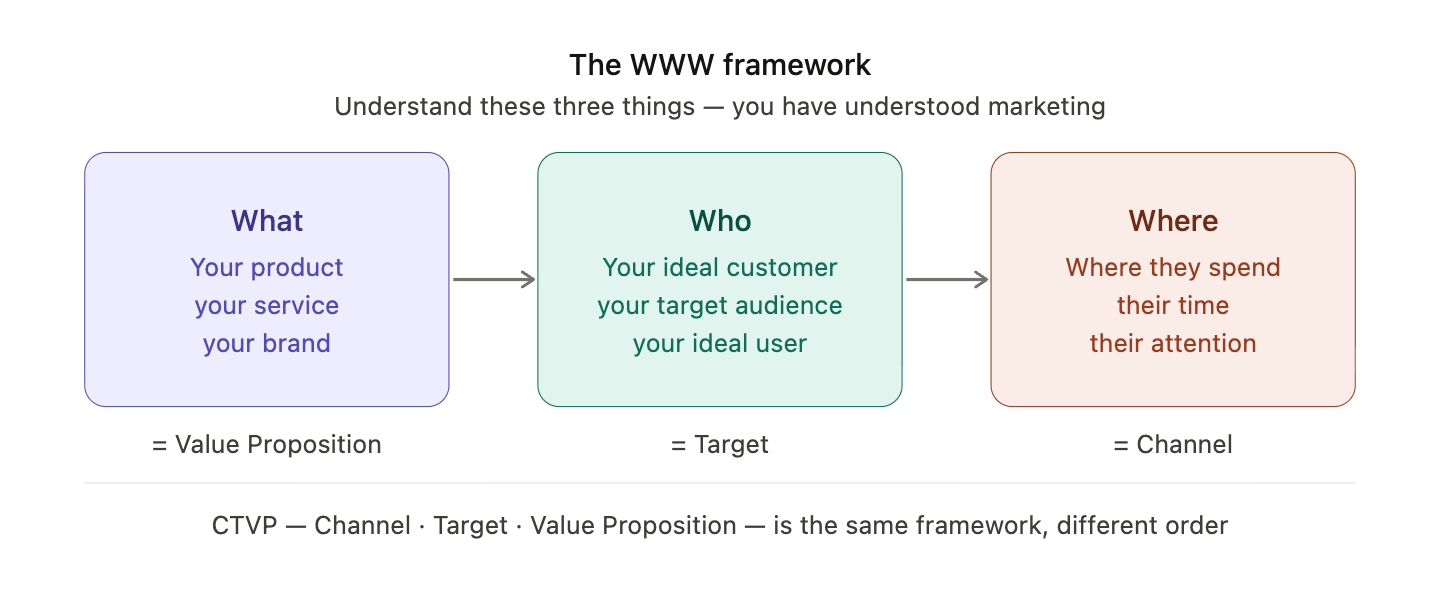
The first one, which is the easier to remember, is the W W W:
What — What is your offer? Your product, your service, your brand.
Who — Who is your ideal audience, your ideal customer, your target audience?
Where — Where do they spend their time? Where are they spending their attention?
Once you figure out those three things, you have understood marketing.
The CTVP Framework
Another version of that, which is pretty much the same thing, is the CTVP:
Channel — The where. What is the marketing channel where they spend their time?
Target — The target audience.
Value Proposition — Your offer, your product, and the messaging.
Where Do People Spend Their Attention?
Now once you understand that, well, let’s talk about what is, in my opinion, the most important — the where. Because where do people spend their time and where do people spend their attention?
Let’s remove the online factor here and let’s go back a couple of decades ago. There was no TV, no internet, no nothing, no radio, no nothing. Okay. Where do people spend their time? On the street. In — this is why at the time, if you wanted to do marketing, what you would usually do is have some kind of billboard. Because this is where most people spent their time. Going to work, going to the bar, whatever. They were on the street.
Now let’s go back to 2026 and let’s focus only on online. There are only a few places where a massive amount of people spend their attention. I want to emphasize the idea of massive amount of people. Because sure, we can argue that one way to get your ideal audience’s attention is to go on a forum, on a community, on an event, or something like that, which might work. But you do not have the scale factor.
That means if you wanna reach a massive amount of people, you wanna go to places where a massive amount of people spend their attention. And turns out there’s not a lot of places. There’s only a few places really. So I’ve tried to categorize them.
Category 1 — Search Platforms
So obviously when we’re talking about search platforms, we are thinking about Google. Yes. That is one. But we also think about Amazon. That is another search platform. And obviously the new one — AI chatbots, so ChatGPT, Claude, and stuff like that. But that is the same category. You are searching for something, whether it is information on Google, or on ChatGPT, whether it is a product on Amazon. We could also technically add YouTube as well.
Category 2 — Social Media Platforms
Here, anything from YouTube, Instagram, TikTok, YouTube Shorts — which is kinda different, kinda the same platform, kinda different. Even LinkedIn to some extent, Twitter, and so on and so forth.
The key difference here is you wanna have — this is the second category where people spend their time online. The big difference is that here, they are going on that platform with the intent of mainly entertainment. They are not going with a specific search in mind.
Category 3 — Owned Audience
Now owned audiences are anything that a specific group of people — whether it is an individual, a creator, a company, whatever — has been able to capture from most of the time another platform, and just keep them somewhere. So that might be, most of the time, a newsletter. But also it might be a private group community. Here we’re starting to lose the scale aspect, but this is still interesting, and depending on the kind of audience, that might be big.
Category 4 — Platforms Broadly
So these are platforms that most of the time do not fit any other previous category. We are talking about Spotify. Technically it might be — it’s not really a social media, but pretty much anybody can put content out there. But you don’t have that algorithm factor. So kinda weird, this is where I put it. That might also be Airbnb — to some extent, there’s a vast amount of people here. That might also be the App Store or the Play Store. If you are doing some kind of mobile application, you wanna be here.
Category 5 — Private Communications
This is more like sales and outreach. So email, DMs, whatever. But again, if you think about this, most of the time DMs are linked to a social media platform.
The only exception I’d say is the paid aspect. Most of the time, paid is going to be on one specific platform. If you’re doing Google Ads, you are going to pay to get the attention of people on an existing platform — in that case, Google. If you’re doing Meta Ads, you are going to pay for getting people’s attention from Instagram and Facebook. The only exception to that would be display ads — here, this is where you might have ads inside a video game or mobile game or something like that. So this is a bit broader and does not fit any category.
But except that exception, I do think — and again, correct me if I’m wrong — that these are the only places online where there’s a massive amount of people spending their time and attention.
So if you want to sell something — and by the way, I think this is why I’m fascinated by this. Because this works for anything. Sure, it works for a business, this is what I’m trying to do. But that works if you are trying to sell — what if you are an artist and you wanna sell and get eyes on your music? You are going to be faced with the same problem. What if you are trying to sell your movie? Same problem. What if you are trying to sell a community, or just something local like a local gym? Same problem.
At the end of the day, you wanna get people’s attention.
The Only Ways to Get People’s Attention at Scale
I’m going to end the explore part on this. If you wanna get people’s attention at scale, here are the only few ways you can do it. I’ve divided this into two parts.
Part A — What you can do yourself (or the company):
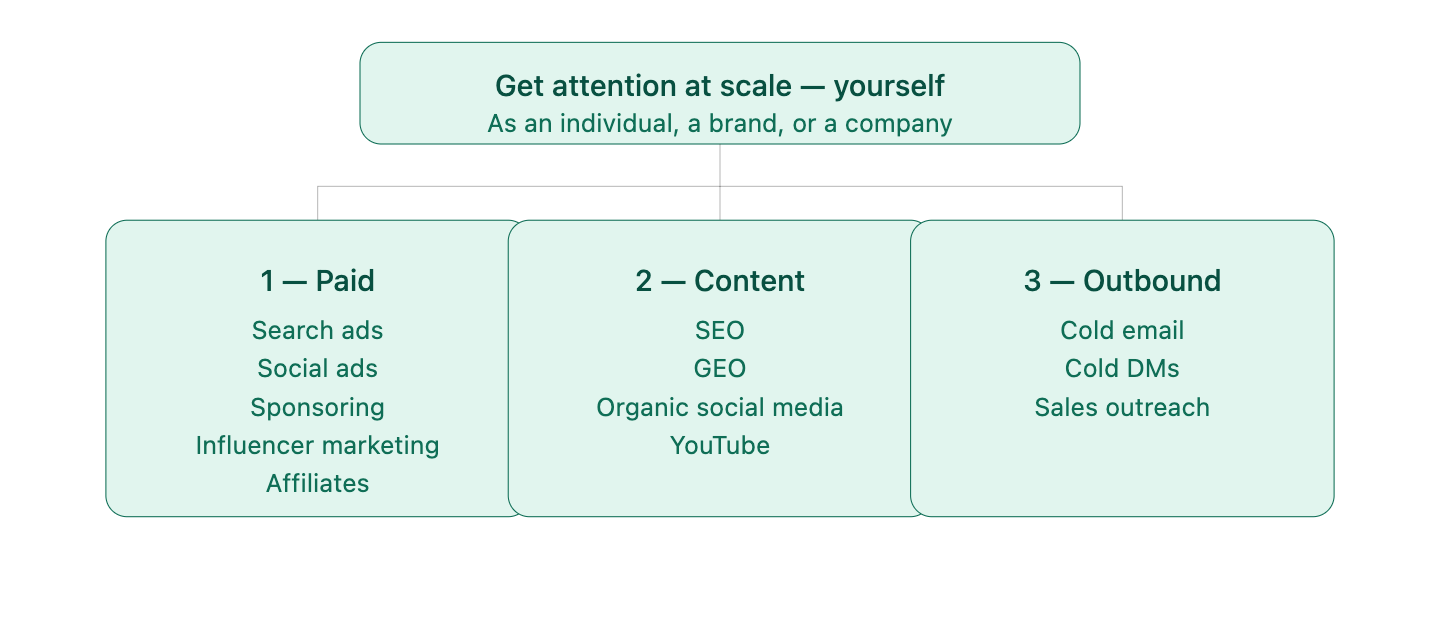
Paid — Search ads, social ads, sponsoring, influencer marketing, affiliates, whatever.
Content — SEO, GEO, organic social media.
Sales and outbound — Cold email, cold DMs, outreach.
Those are the only three ways you can do that yourself.
Part B — Using other people to get your ideal customer’s attention:
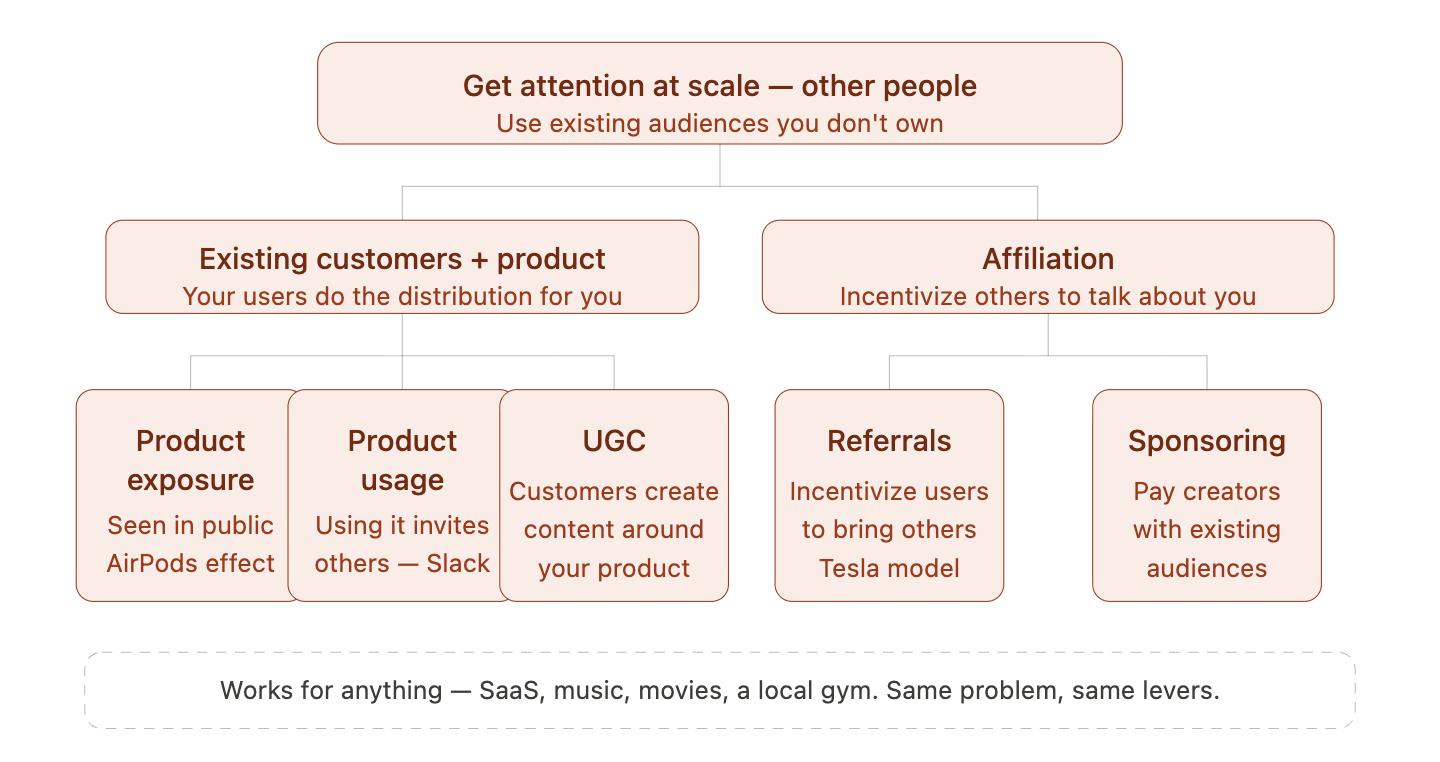
The first way is to use your existing customers / product:
Product exposure — The classic example is AirPods. Apple is using their existing customer base and every person that is buying AirPods and using them when walking or going anywhere, people will see around them that you have AirPods. So this is product exposure.
Product virality — What they usually call product virality is product usage. By the idea of using the product, you ask people and invite more people to use the product and become users. The Slack example is a very good one. If you are using Slack, you wanna onboard your whole team on it. So you, as the customer, by using the product, will invite more users to the product.
User Generated Content — I think this is very interesting even though not a lot of people are talking about it. Basically, you want to incite people by different means to create content around your product. Customers are going to create content around your product because of what they’ve been able to do with it. Maybe it’s because it’s amazing, maybe because it is technologically impressive, maybe it’s to flex, maybe there’s no reason — but you wanna find a way.
The second way is affiliation:
Referral programs — Basically, you wanna incite people, most of the time with money, to talk about your product. Tesla has been known for doing that in the very early stages.
Sponsoring — You just wanna sponsor creators and stuff like that.
And this, in my opinion — which again I might be wrong, but I think I’ve done a lot of research on the topic — are the only really ways to get people’s attention online at scale.
Part 3 — Level Up: Personal Brand Launch
Well, that moves me on to the final part of this episode, which is level up.
So in level up, I’m talking about something I’ve learned and grown from in the last week. And that week, I signed up for the Personal Brand Launch — PBL — serviced by Ava on social media.
Basically, they are going to help me over the next three months to create short form content on social media, to create a brand and to build around the product. I’m very interested to see — it’s already started, last Friday if I’m being correct. So that’s going to be very interesting to see what they’re gonna do for me, how they’re gonna do it, what kind of contents they are going to produce.
What I’m also very interested in is to understand the behind the scenes and the different parts of the workflow. Especially the research and scripting part — to find outliers. And a little secret here — I’m planning on creating an AI that can do that. That can, for a specific niche, search on TikTok and Instagram, research the best content and the best creators around that niche, find the outlier videos and content, and then from those outliers, analyze them — analyze the hook both from a transcript point of view but also from a visual point of view, the content, the CTA — so that the AI can automatically do this job and basically give you a research work with everything it found around your niche.
And then what you as a human — again, AI is very good, but AI will never be creative. You have to be creative to use the right hook with your right branding tone, and just creativity. So I’m also very interested — not only from a product creation perspective, but also for me personally — to understand how it works, and does it work, is it possible? So we’re gonna see. I’m going to keep you updated in the next couple of weeks to see how it goes.
Music of the Week
And finally, this episode is coming to an end. This week, let’s go back to some classic. I felt like last week — that was about Top Gun, that was very good. But this week, it’s about going back to NF.
You probably don’t know this, but I’ve been a huge fan of NF since almost ten years now. And I think that man and that artist had more influence on my life than my parents. That is impressive. I really — I can talk about this for hours, but this is not the point of the episode, unfortunately. But that is pretty much impressive how this guy has been able to not only have that kind of grind and success and you know, achieve his career, first. Second, there’s a really artistic point of view that I really like and I do not have right now in my life. And third, he kept that family values that are very important to me. He managed to keep that in his life, which is beyond impressive.
So let’s go with NF. Remember This. That is one of my favorite songs. It’s been a while. Let’s listen to this again.
Well, on those beautiful notes, I wish you a good day, and I’ll see you very soon.